What to Do After ChatGPT Gives You a Business Plan
 By Cuong Nguyen, Founder of BuildYourBusinessUpdated May 20268 min read
A business plan from ChatGPT is a useful first draft, not a finished plan. To make it real, pressure-test its assumptions, replace its generic numbers with yours, validate it with real customers, and turn it into steps you actually act on.
A ChatGPT plan arrives looking impressive: clean sections, confident language, a tidy structure. That polish is exactly the trap. It reads as finished when it is really a generic template filled in with plausible guesses about your business. The model has never met your customers, does not know your costs, and cannot tell whether anyone will pay. None of that makes it useless. It makes it a fast, free starting point, the blank page already broken. The work that turns it into a real plan is the work the model could not do: testing whether its assumptions hold, putting in your actual numbers, checking it against real people, and converting it from a document into a sequence of steps you live by. This guide walks through exactly that.
Why a ChatGPT business plan is only a starting point
The problem is not that the plan is wrong. It is that it is generic and unproven, dressed in confident language that hides both. A language model produces the most likely-sounding plan for a business like yours, which means it leans on averages and common patterns. It fills in market sizes, pricing, and growth numbers that sound reasonable but are not yours. And it presents all of it with the same certainty whether the claim is solid or invented. The danger is acting on it as if it were validated, when really it is a well-written hypothesis. Treat it as a draft to interrogate, not a verdict to follow.
How do you turn a ChatGPT plan into a real one?
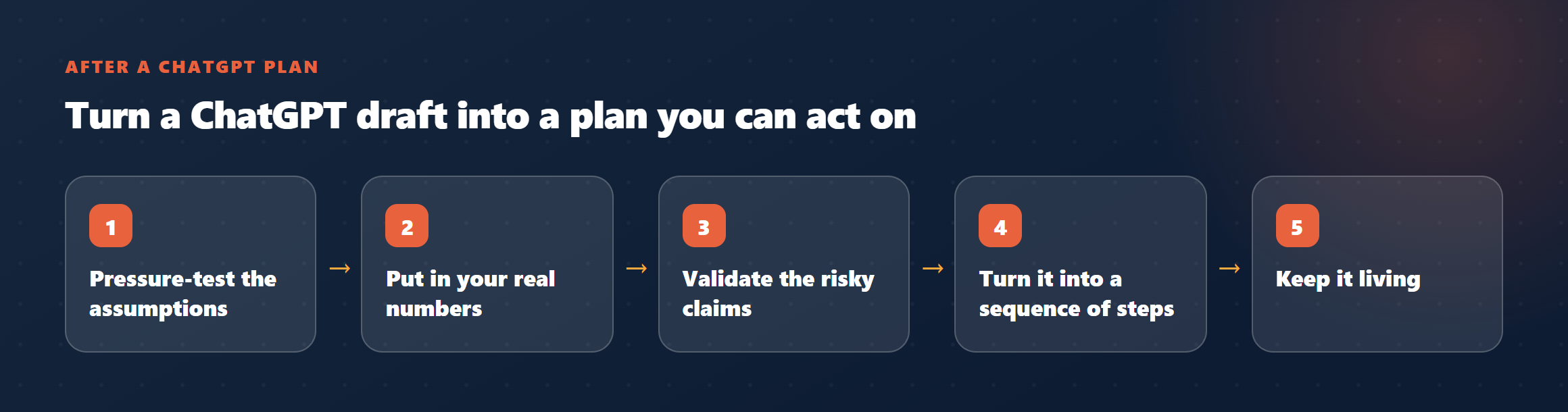
Work through it in this order. Each step replaces a guess with something real.
- Pressure-test the assumptions. Read each section and ask "how does it know that." Underline every claim about your customer, your price, or your market that the model could not actually know. Those are your to-do list.
- Put in your real numbers. Replace the invented financials with your actual costs, your real price, and honest estimates you can defend. This is where a generic plan becomes yours.
- Validate the risky assumptions with real people. Take the biggest underlined claims and check them with five to ten real potential customers. Their reaction beats the model's confidence every time.
- Turn it into a sequence of steps. A plan you cannot act on is just a document. Break it into a short list of outcomes, what to do first, second, third.
- Keep it living. Update it when reality teaches you something the plan assumed wrong. A plan that never changes is already out of date.
What ChatGPT leaves out
Three things, and they are the three that decide whether the business works. It leaves out your specifics, because it does not know them. It leaves out validation, because it cannot talk to your customers. And it leaves out execution, because the moment you close the chat, the plan stops moving while your business keeps going. A document that does not stay connected to what you do each week quietly becomes useless. Filling those three gaps is the whole job after the draft.
The numbers
- The most-cited reason startups fail is building something with no real market need, named in 42% of failures. A confident but unvalidated plan does not protect you from this; only checking with real people does. (CB Insights, Top Reasons Startups Fail)
- A meta-analysis of 46 studies found that planning improves performance most when it is paired with real action and updated over time, not when it sits finished in a drawer. (Brinckmann, Grichnik & Kapsa, Journal of Business Venturing, 2010)
What this looks like in practice
Picture a founder who asks ChatGPT for a plan for a meal-prep service. It returns a polished document assuming busy professionals are the customer and a confident revenue forecast. She does the real work after: she underlines the customer and pricing assumptions, talks to ten people, and learns the people who actually reach for their wallet are not busy professionals but new parents. She rewrites the plan around them, puts in her real ingredient costs, and breaks it into a first-month sequence. Same starting draft, completely different and now real plan. The ChatGPT version was the scaffold. The validation made it true.
What a better plan still cannot do
Even a validated, personalized, executable plan is still a set of informed bets, not a guarantee. It will meet reality and need to change. The point of doing this work is not certainty, it is to start with eyes open and a plan you can adjust, instead of a confident document built on guesses. The plan gets you moving in the right direction. It does not do the moving for you.
Frequently asked questions
Is a ChatGPT business plan good enough for a bank or investor?
Not on its own. Reviewers can spot a generic AI plan quickly, and the parts they care about most, your real numbers and evidence of demand, are exactly what the draft lacks. Use it as a skeleton, then make it specific and validated.
Can I just keep asking ChatGPT to improve the plan?
It can keep polishing the writing, but it cannot add what it does not have: your real customers, your real numbers, and what happens once you start executing. More prompting improves the prose, not the truth of the plan.
So was using ChatGPT a waste of time?
Not at all. It gave you a structured starting point in minutes and broke the blank page, which is genuinely useful. The mistake is stopping there and treating the draft as finished.
Turn a generic draft into a plan built around you, that keeps moving
BuildYourBusiness does the work ChatGPT cannot. It builds a plan around your real situation rather than averages, helps you test the risky assumptions, and then stays with you through the side-by-side execution model, turning the plan into a live roadmap that adapts as reality changes. Bring your idea, or the draft you already have. Free to start. No card needed.
Start with my idea