Why Most Business Plans Die in a Drawer (and How to Make One You Will Actually Use)
 By Cuong Nguyen, Founder of BuildYourBusinessUpdated May 20269 min read
Most business plans fail not because they were wrong, but because they were finished. A plan you actually use is a living document that updates as reality changes.
There is a moment every founder knows. The plan is done, it looks impressive, and within a few weeks it is never opened again. The business keeps moving, but the plan stays frozen on the day it was written. This is the quiet failure of almost every business plan: not that the thinking was bad, but that the plan and the real work drifted apart until the document was useless. A plan only helps if it stays connected to what you are doing this week. That means breaking it into outcomes you can act on, checking it against reality often, and updating it when reality disagrees. This guide explains why plans get abandoned, what a plan you will actually use looks like, and how to turn a static document into a daily companion.
Why do business plans get abandoned?
Business plans get abandoned for four predictable reasons. First, they are written once and never revisited, so they freeze in time while the business moves on. Second, they live in a separate document, disconnected from the daily decisions a founder actually makes, so opening them feels like extra work rather than help. Third, they are written in big, vague goals ("grow revenue") instead of the small, concrete next steps that fill a real week. And fourth, reality changes faster than the plan: a channel stops working, a price has to move, a supplier falls through, and the plan still describes a world that no longer exists. The result is a document that is technically complete and practically dead.
What makes a plan you actually use?
A plan you use has three qualities a drawer plan lacks. It is broken into milestones, a short sequence of outcomes rather than one giant goal, so you always know the next thing that matters. It is connected to your week, close enough to your daily work that checking it is natural, not a chore. And it is allowed to change, treated as the current best version rather than a sacred final draft. When something real shifts, the plan shifts with it, on purpose and out loud, instead of quietly going stale. A living plan is less impressive to look at than a polished report. It is far more useful to run a business with.
How do you turn a plan into daily execution?
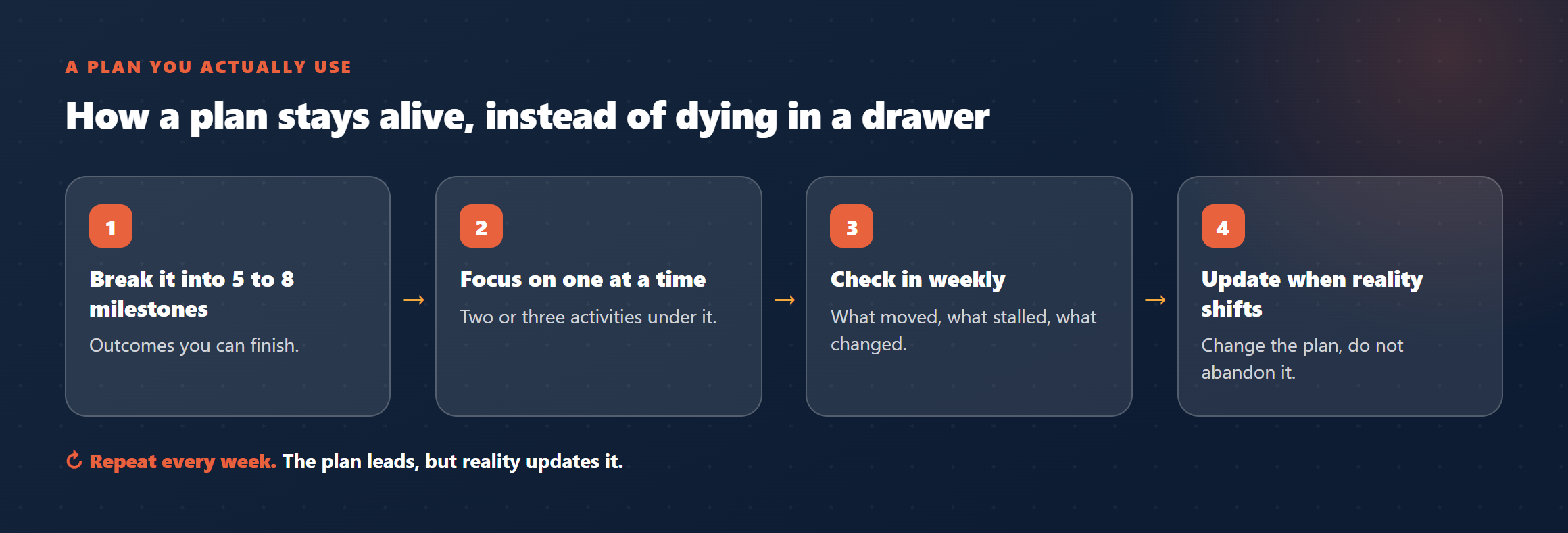
Turning a plan into action is a rhythm, not a one-time event. Run it like this:
- Break the plan into 5 to 8 milestones. Each one an outcome you can finish, like "land your first five paying customers," not a vague theme.
- Pick one focus at a time. Work the current milestone, with two or three concrete activities under it, instead of staring at the whole mountain.
- Check in weekly. What moved, what stalled, what changed in the real world since last week.
- Update the plan when reality diverges. If your revenue model or your timeline changes, change the plan to match. A plan that never updates is already dead.
- Keep the plan as the source of truth. Not a frozen one, a current one. The plan leads, but reality is allowed to correct it.
The numbers: planning works only when it stays alive
- A meta-analysis of 46 studies found business planning improves performance, and that plans paired with action and updated over time outperform rigid, write-once plans. (Brinckmann, Grichnik & Kapsa, Journal of Business Venturing, 2010)
- About 50% of new businesses fail within five years, often not from a bad initial plan but from failing to adapt as conditions changed. (U.S. Bureau of Labor Statistics)
The research lands on one point: the value is in planning as an ongoing habit, not in the plan as a finished object. The founders who do best are not the ones with the prettiest document. They are the ones whose plan kept up with where they actually were.
A plan that dies versus a plan that lives
| A plan that lives | A plan that dies in a drawer | |
|---|---|---|
| Shape | A sequence of milestones | One long document |
| Updated | Whenever reality changes | Written once, never again |
| Connection | Tied to this week's work | A separate file you forget |
| When things go wrong | The plan adapts | The plan is ignored |
| Role | A companion you work beside | A trophy you wrote once |
What this looks like in practice
Picture a founder whose plan assumed she would sell directly to customers online. Three weeks in, the real signal is different: every serious buyer is a local cafe that wants wholesale, not individuals. A drawer plan would still say "build the online store," and she would either follow a dead plan or abandon it. A living plan does something else. It notices the divergence, flags that the revenue model has shifted, and proposes a change: move wholesale accounts to the front of the roadmap, push the online store back. She confirms, and the plan now matches reality instead of fighting it. The plan did not break. It adapted, which is the entire point.
What a living plan still cannot do
A plan that adapts is not a plan that works for you. It still needs you to show up, do the work, and make the calls. A living plan removes the excuse of a stale document and the paralysis of a giant goal, but it cannot manufacture effort or judgment. It makes the right next step obvious and keeps you honest about where you are. The walking is still yours to do.
Frequently asked questions
How often should I update my business plan?
Check it weekly, update it whenever something real changes, your customer, your price, your timeline, your channel. There is no fixed schedule. The trigger is reality disagreeing with the plan, not a date on the calendar.
Is a business plan still worth writing if it will change?
Yes, precisely because it will change. The plan is your current best thinking, the baseline you measure reality against. Without it you cannot tell whether you are on track or drifting. You just need to treat it as living, not final.
What is the difference between a business plan and execution?
A plan is the decision about what to do. Execution is doing it, and noticing when the plan needs to change. Most tools stop at the plan. The hard, valuable part is the part that comes after.
A plan that walks beside you, not one that gathers dust
This is the gap BuildYourBusiness was built for. Most tools hand you a plan and disappear. BuildYourBusiness turns your plan into a live roadmap and stays with you through the side-by-side execution model: it tracks where you actually are, surfaces what matters this week, and when reality diverges from the plan, it adapts with you instead of going stale. Free to start. No card needed.
Start with my idea