What Actually Goes Into a Business Plan (and What You Can Skip)
 By Cuong Nguyen, Founder of BuildYourBusinessUpdated May 20269 min read
A useful business plan has about ten parts, but only a handful decide whether the business works. The rest are supporting detail you can keep short.
Most founders either skip the business plan entirely or drown in a fifty-page template they never reread. Both are mistakes. A plan is not paperwork. It is the place where you make the handful of decisions the business actually rests on: who you serve, what you sell, how you reach them, and whether the money works. A complete plan does cover about ten sections, because a reader needs the whole picture to trust it. But four or five of those sections carry the weight, and the rest exist to support them. The skill is knowing which is which, so you spend your thinking on the parts that change the outcome and keep the rest tight. This guide walks through every section, what it is for, and how deep to go on each.
What are the essential parts of a business plan?
A modern, founder-friendly business plan has ten sections. They are best generated in this order, because each one builds on the last:
- Market research — who the customer is, how big the market is, and what the competition looks like.
- Products and services — what you sell and why it is a better fit than the alternatives.
- Marketing and sales — how you reach buyers and turn attention into revenue.
- Team and people — who does the work, and what skills are missing.
- Operations — how the thing actually gets made and delivered, day to day.
- Financials — pricing, costs, and the path to covering your own bills.
- Risk assessment — the real things that could go wrong, and how you would handle them.
- Data security and governance — how you keep customer information safe.
- Implementation roadmap — the first 90 days, in phases.
- Executive summary — the one-page version, written last, that ties it all together.
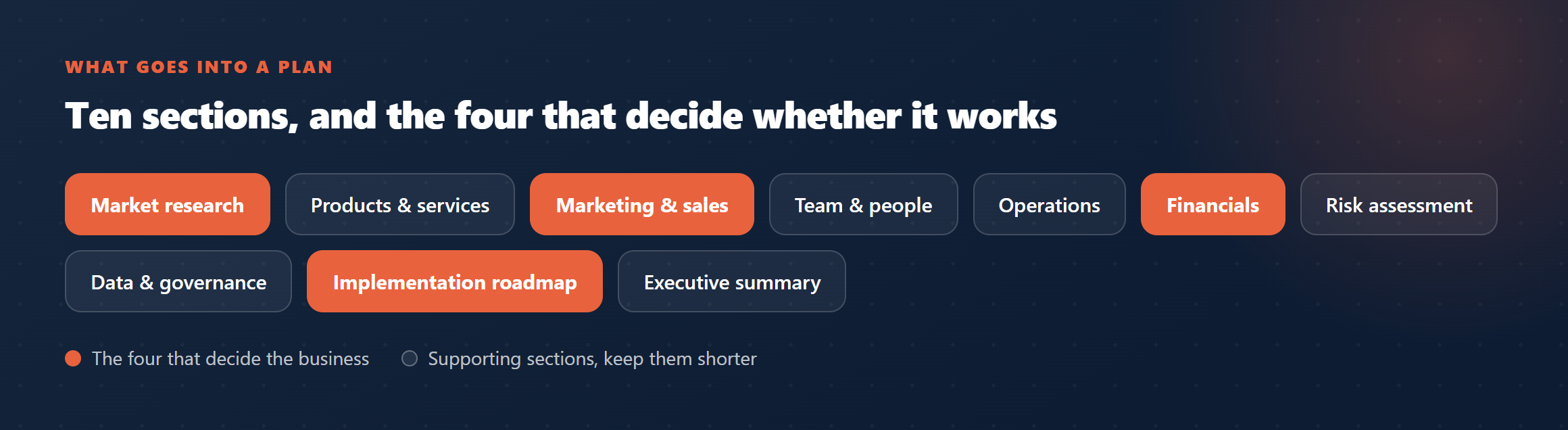
Which sections actually decide whether the business works?
Four sections carry most of the weight. Market research decides whether anyone wants this. Marketing and sales decides whether you can reach them affordably, which is where most early businesses quietly fail. Financials decides whether the numbers leave you a profit instead of a wage. And the implementation roadmap decides whether any of it actually happens. If you only had a weekend, you would spend it here. These four are where a plan earns its keep, because a wrong answer in any one of them is the kind of mistake that costs months. The other six sections matter, but they support these four rather than replace them.
What can you skip or keep short?
You do not skip sections, you right-size them. A solo founder does not need three pages on team structure, but they do need one honest paragraph on which skills they lack. Data security can be a short, sensible section for most early businesses, not a compliance essay. The executive summary should be one page, never five. The rule is simple: go deep where a wrong answer would hurt, and stay brief where the section is there for completeness. A plan that is all the same depth everywhere is a plan that wasted your time on the parts that did not matter.
Do you even need a business plan?
You need one, but later than you think. Write the plan after you have evidence the idea holds up, not before. A plan built on an unproven idea just documents a guess in a confident voice. Once you know people want what you are building, a plan turns that knowledge into something you can act on, raise money against, and hand to a teammate. The order matters: check the idea first, then plan, then build.
The numbers: does planning actually help?
- A meta-analysis of 46 studies found that business planning improves the performance of both new and established firms, with the biggest gains when the plan is paired with real action. (Brinckmann, Grichnik & Kapsa, Journal of Business Venturing, 2010)
- About half of new businesses are gone within five years, and the most common avoidable cause is building something with no clear market. (U.S. Bureau of Labor Statistics; CB Insights)
The evidence is not that a thick document saves you. It is that the thinking does, as long as the plan stays connected to what you actually do next. A plan in a drawer helps no one. A plan you work from changes the odds.
Core sections versus supporting sections
| Section | Decides the business | Supports the plan |
|---|---|---|
| Market research | Yes, go deep | — |
| Marketing and sales | Yes, go deep | — |
| Financials | Yes, go deep | — |
| Implementation roadmap | Yes, go deep | — |
| Products and services | — | Keep focused |
| Team and people | — | One honest paragraph |
| Operations | — | Right-size to the business |
| Risk, security, summary | — | Short and sensible |
What this looks like in practice
Picture a founder opening a small specialty coffee roastery. The sections that decide everything are clear once you look: market research tells her there are four roasters in town and a gap for single-origin subscriptions; marketing and sales is where she works out that wholesale cafe accounts, not walk-ins, are how she reaches volume; financials reveal her real constraint is the price per bag, not the cost of beans; and the roadmap turns it all into a first-90-days sequence. Her team section is two sentences, because it is just her for now. That is a complete plan that took its depth where the business actually lived.
What a business plan will not do for you
A business plan is a well-reasoned set of assumptions, not a promise. It cannot predict the month a key supplier raises prices or a channel stops working. The danger is treating the plan as finished the moment it is written. The best plans are living documents that get updated as reality teaches you something the plan assumed wrong. A plan is the start of execution, not the end of thinking.
Frequently asked questions
How long should a business plan be?
Long enough to cover the ten sections honestly, short enough that you reread it. For most early businesses that is a focused document, not a fifty-page report. Depth belongs in the four core sections, not everywhere.
Do investors still read business plans?
Most read the executive summary and the financials first. A clear one-page summary and credible numbers earn the meeting. The full plan proves you have thought it through when they ask.
Can AI write my business plan?
AI can produce the structure and the first draft quickly, which saves real time. The judgment, the pricing, the customer, the trade-offs, still has to be yours. The best use is AI for the scaffolding and you for the decisions.
Get a plan built around your business, not a blank template
BuildYourBusiness turns your idea and your feasibility read into a complete, personalized plan across ten core sections, in your industry's language, not a generic fill-in-the-blanks document. And unlike a plan that ends as a PDF, it carries straight into daily execution, walking beside you as you build. Free to start. No card needed.
Start with my idea