How to Tell If Your Business Idea Is Actually Worth Pursuing
 By Cuong Nguyen, Founder of BuildYourBusinessUpdated May 20268 min read
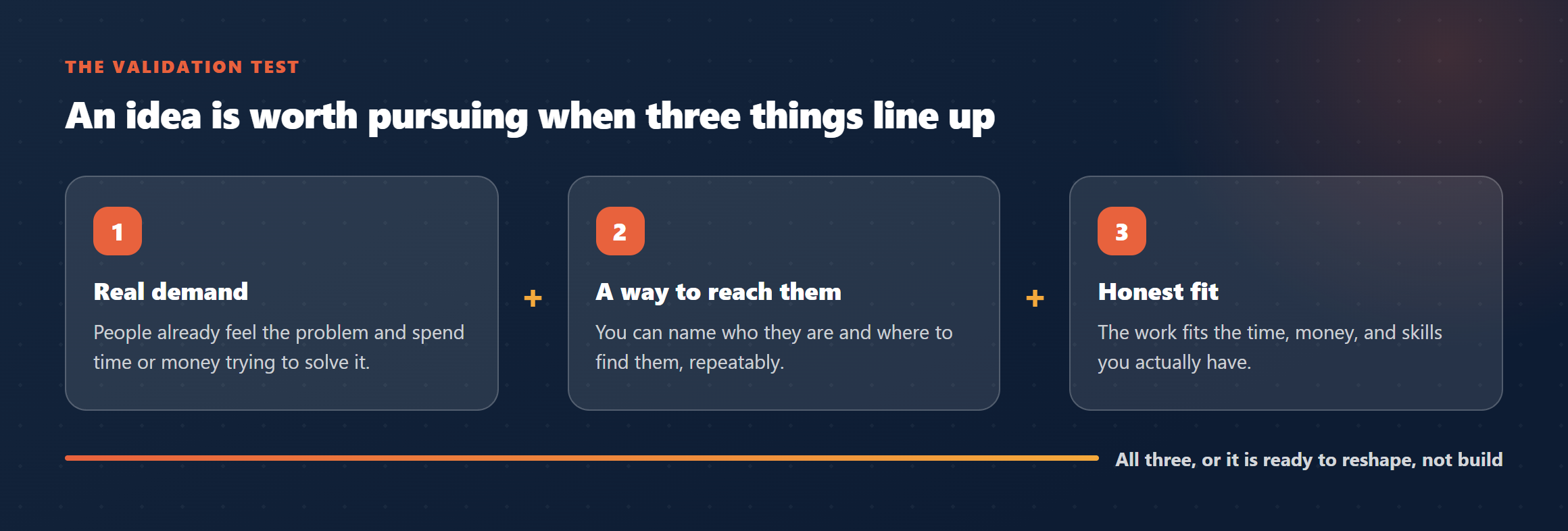
A business idea is worth pursuing when three things line up: real demand, a believable way to reach the people who have the problem, and an honest fit with the time, money, and skills you actually have.
Most founders judge an idea by how excited it makes them. That is the wrong test. An idea is worth pursuing when those three things are true at the same time: enough people already feel the problem and spend time or money trying to solve it, you have a believable way to reach them, and the work fits the resources you actually have. A clever idea that fails any one of these is not ready to build. It is ready to reshape. The encouraging part is that you can check all three in a week or two, before you spend real money, by talking to real potential customers and watching what they do rather than what they say. This guide walks through how to run that check, what the signals look like, and how to tell an idea worth pursuing from one that still needs work.
What makes a business idea worth pursuing?
A strong idea is not the most clever one. It is the one that survives four honest questions:
- Is there real demand? Real demand means people already feel this problem and already spend time or money trying to solve it. A problem nobody is trying to solve is a hard sell, no matter how good your solution is.
- Can you reach the people who have it? An idea is only a business if you have a believable way to put it in front of buyers. If you cannot picture where these people are, that is a gap to close before you build.
- Will it make money at a price people accept? The price a customer is happy to pay has to sit comfortably above what it costs you to deliver. If the two are too close, you have a hobby, not a business.
- Does it fit you? The right idea for someone with ten years and a big budget is the wrong idea for someone building on evenings and weekends. Fit is not a weakness to hide. It is information.
How do I know if there is real demand for my idea?
Look for evidence that people already act on the problem, not just agree it exists. The strongest signal is money: people paying for a workaround, even a clumsy one, proves they will pay to solve this. The next strongest is effort: people building their own fixes, asking for help in communities, or searching for a solution. Polite agreement ("nice idea") is the weakest signal of all, because it costs nothing to say. Before you build anything, find five to ten people who have the problem, ask how they handle it today and what it costs them, and watch whether they lean in or shrug. Existing competitors are a good sign here, not a bad one. A market with no competitors usually means no one has found a way to make money in it yet.
How long should it take to check an idea?
For most early ideas, a focused week or two is enough to know whether to keep going, reshape, or stop. You do not need a finished product or a budget. You need conversations, one simple landing page or pre-sale, and the willingness to hear an answer you did not want. The goal at this stage is not certainty. It is enough evidence to commit with your eyes open, instead of betting a year of your life on a guess.
The numbers: how often ideas fail, and why
- Roughly 20% of new businesses fail within their first year, and about half are gone within five years. (U.S. Bureau of Labor Statistics, Business Employment Dynamics)
- When CB Insights reviewed why startups fail, "no market need" was the most-cited reason, named in 42% of failures. (CB Insights, Top Reasons Startups Fail)
Read those together and the lesson is clear. The most common way to fail is not bad code or a weak logo. It is building something the market did not actually need. Almost all of that risk can be removed before you spend real money, by checking the idea first.
Validation simply means gathering evidence that people want what you plan to build, before you build it.
Signs your idea is worth pursuing (and signs it is not)
| Signal | Worth pursuing | Needs reshaping |
|---|---|---|
| The problem | People already pay or work to solve it | You have to convince people it is a problem |
| The customer | You can name who they are and where to find them | "Everyone" is the customer |
| Willingness to pay | People have paid for a worse fix already | "Nice idea," but no one reaches for a wallet |
| The money | Price sits well above your cost to deliver | The margin is thin or unclear |
| Your fit | Matches your time, budget, and skills | Only works if everything goes perfectly |
| The competition | A few rivals exist and are making money | Total silence, no one else is trying |
What this looks like in practice
Picture a side-builder with an idea for a meal-prep service aimed at busy nurses. Instead of cooking anything, she spends two weeks on evidence. She talks to twelve nurses about how they eat on shift, and learns most already pay for sad gas-station food they dislike. She puts up a one-page site describing the service with a single "reserve a week" button, and shares it in two nursing groups. Nine people reserve, and three ask when they can pay. That last detail, real people trying to pay before anything exists, is the green light. The idea was worth pursuing. The version she imagined on day one was not quite right, but the check told her which part to keep.
What checking your idea does not tell you
Validation tells you whether people want the thing. It does not tell you whether you can build it well, price it right, or grow it. A validated idea can still fail in the building, when a founder runs out of time, money, or focus. Checking the idea is one filter, the cheapest and earliest one, not the only one. It earns you the right to plan and build with confidence. It does not replace the work of actually executing.
Frequently asked questions
What if my idea already exists?
That is usually good news. Competitors prove that people will pay. Your job is not to be first. It is to be a clearly better fit for a specific group of customers.
Do I need a business plan to validate my idea?
No. Validate first, plan second. A plan built on an unproven idea just documents a guess. Once the idea holds up, a plan turns it into something you can execute.
How much money should I spend checking an idea?
Close to nothing. Conversations are free, and a basic landing page or pre-sale costs very little. If checking an idea is expensive, you are probably building instead of testing.
Find out if your idea holds up, before you bet a year on it
Describe your idea in a guided conversation, and the Test phase gives you an honest feasibility read: where the market is real, where your idea is strong, and where the risks sit, with plain guidance on what to fix. And unlike a one-time report, BuildYourBusiness keeps walking beside you afterward, through building and daily execution. Free to start. No card needed.
Start with my idea