How to Validate a Business Idea Before You Quit Your Job
 By Cuong Nguyen, Founder of BuildYourBusinessUpdated June 20269 min read
You can validate a business idea while you still have a job, and you should. The goal is to gather real evidence that people want what you plan to build before you give up a steady income, not after.
Quitting a job to chase an idea is one of those decisions that feels brave and reckless at the same time. The good news is that you almost never have to make it blind. Validation, which simply means gathering proof that people want your idea before you build it, does not require a finished product, a budget, or a free calendar. It requires a handful of real conversations, one small test, and the honesty to read what people actually do rather than what they politely say. All of that fits inside evenings and weekends. This guide is written for the person building on the side: how to run a real check around a full-time job, how much you should prove before you hand in your notice, and how to tell the difference between an idea that is ready and one that just feels ready.
Can you really validate an idea while working full time?
Yes, and working full time is an advantage, not a handicap. A steady income is the thing that lets you test calmly instead of desperately. Founders who quit first often rush their validation, because every week without proof is a week of savings burning, and a rushed test tells you what you want to hear. You do not have that pressure yet. Your job is paying you to be patient. The constraint that matters is not money, it is time and energy, so the whole approach below is built to need very little of both: a few focused hours a week, not a second full-time job.
What does validation look like on evenings and weekends?
It looks like three small things done in sequence, not a grand launch. First, talk to five to ten people who have the problem you want to solve, and ask how they handle it today and what it costs them. These can be calls or messages spread across a week or two. Second, put up one simple page that describes what you would offer and asks for a single small commitment: a reservation, a waitlist email, a pre-order. Third, watch what people do. An email costs them nothing, so it is a weak signal. A reach for a wallet, or a "when can I pay," is a strong one. None of this needs you to leave your job, and all of it gives you evidence that a spreadsheet of assumptions never will.
How much should you prove before you quit?
Enough that you are leaving for a known opportunity, not a hope. There is no universal number, but a useful bar is this: you have spoken to real potential customers, more than a few have shown they will pay (not just that they like the idea), and you can see a believable way to reach more of them without relying on luck. Many side builders go further and earn their first real revenue while still employed, which is the strongest validation there is. The point of staying employed is to keep buying yourself evidence. Quit when the evidence, not the excitement, says the income on the other side is real enough to replace what you are giving up.
The numbers: how often new businesses fail, and why
- Roughly 20% of new businesses fail within their first year, and about half are gone within five years. (U.S. Bureau of Labor Statistics, Business Employment Dynamics)
- When CB Insights reviewed why startups fail, "no market need" was the most-cited reason, named in 42% of failures. (CB Insights, Top Reasons Startups Fail)
Read those together and the lesson for a side builder is sharp. The most common reason businesses fail is not running out of effort, it is building something the market did not need. That is exactly the risk you can remove from your kitchen table, for almost no money, before you ever risk your salary. Validating on the side is not the cautious option. It is the smart one.
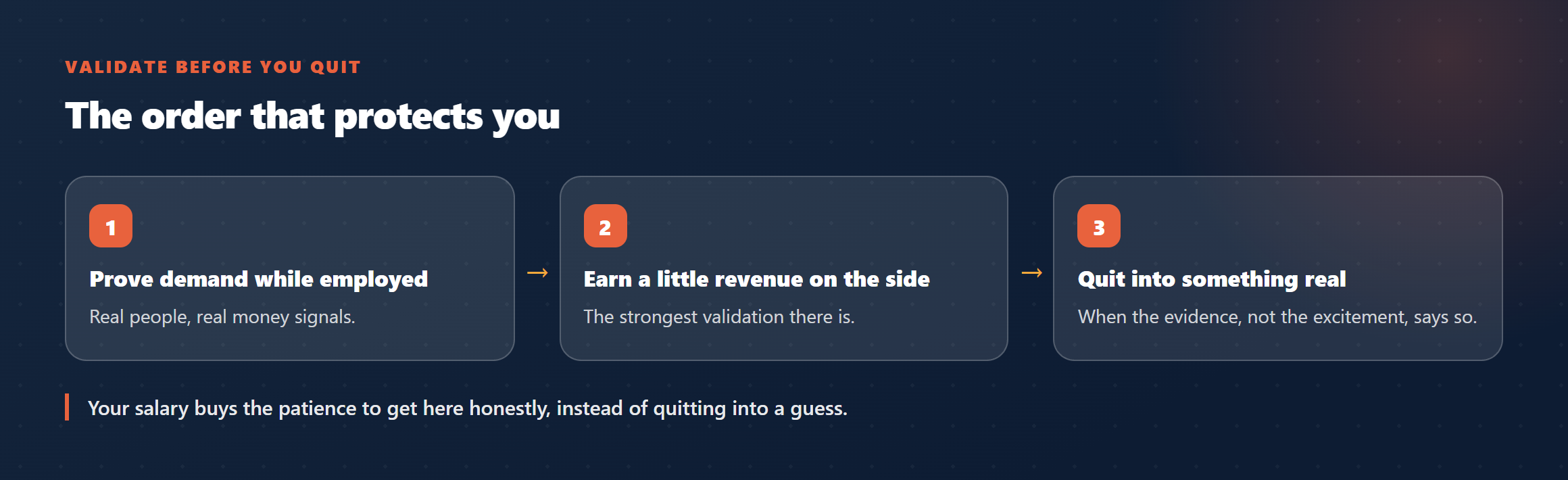
The order that protects you: prove demand while employed, earn a little revenue if you can, then quit into something real, rather than quitting into a guess.
Signs you are ready to go full time (and signs you are not)
| Signal | Ready to consider it | Not yet |
|---|---|---|
| Demand | Real people have paid, or pre-paid, already | People say they love it, but no one has paid |
| Reach | You know where to find more customers, repeatably | Your only customers are friends and family |
| Revenue | A first trickle of real income while employed | Zero income, only interest and encouragement |
| Runway | Savings to cover months of slow ramp-up | Quitting is the only way to afford to start |
| The signal | Demand is growing without you pushing hard | Every sale takes heroic personal effort |
What this looks like in practice
Picture someone with a full-time marketing job and an idea for done-for-you bookkeeping aimed at freelance designers. Instead of quitting, he spends three weeks of evenings on evidence. He messages a dozen designers and learns most dread their quarterly taxes and already pay for software they do not understand. He puts up a one-page site offering a fixed monthly service with a "reserve your spot" button, and shares it in two designer communities. Seven people reserve, and two ask to pay for the first month right away. He takes those two on, on weekends, while keeping his job. Three months later he has a small but real income, a waitlist, and a clear way to reach more. Only then does he start counting the months of savings it would take to go full time. The salary bought him the patience to get there honestly.
What validating on the side cannot tell you
Validation tells you whether people want the thing. It does not tell you whether the business can survive your full attention, scale beyond evenings, or replace your whole salary. A side test that works on weekends can still strain when it becomes your only job and your only income. Staying employed protects you from one big risk, building the wrong thing, but it does not remove the others. Use this to leave with your eyes open, not to convince yourself the hard part is over. Proving people want it earns you the right to plan the leap properly. It does not make the leap free.
Frequently asked questions
How long does it take to validate a business idea on the side?
For most ideas, a few weeks of focused evenings is enough to know whether to keep going, reshape, or stop. You are looking for a handful of real conversations and one small test, not a finished product. If it is dragging on for months, you are probably building instead of testing.
Should I tell my employer I am working on a business?
That depends on your contract and your relationship, and it is worth checking your employment agreement for anything about side work or intellectual property. Many people validate quietly and legally on their own time and equipment. This guide is about the evidence, not legal advice, so when the stakes get real, confirm the specifics for your situation.
What if I cannot afford to quit even after it works?
Then do not quit yet. A validated idea with a little revenue is a strong position, not a deadline. Keep growing it on the side until the income and your savings make the leap survivable. Patience while employed is a strategy, not a failure.
Find out if your idea holds up, before you bet your income on it
Describe your idea in a guided conversation, and the Test phase gives you an honest feasibility read: where the demand is real, where your idea is strong, and where the risks sit, with plain guidance on what to fix first. And unlike a one-time report, BuildYourBusiness keeps walking beside you afterward, through planning and the day-to-day of building it on your own schedule. Free to start. No card needed.
Start with my idea